
How AXON works
Gate → select anchors → reveal supportive context.
A lightweight gate checks every denoising step. When uncertain tokens lack support, AXON picks anchors with a submodular coverage objective and reveals them; otherwise the base decoder's proposal goes through unchanged.
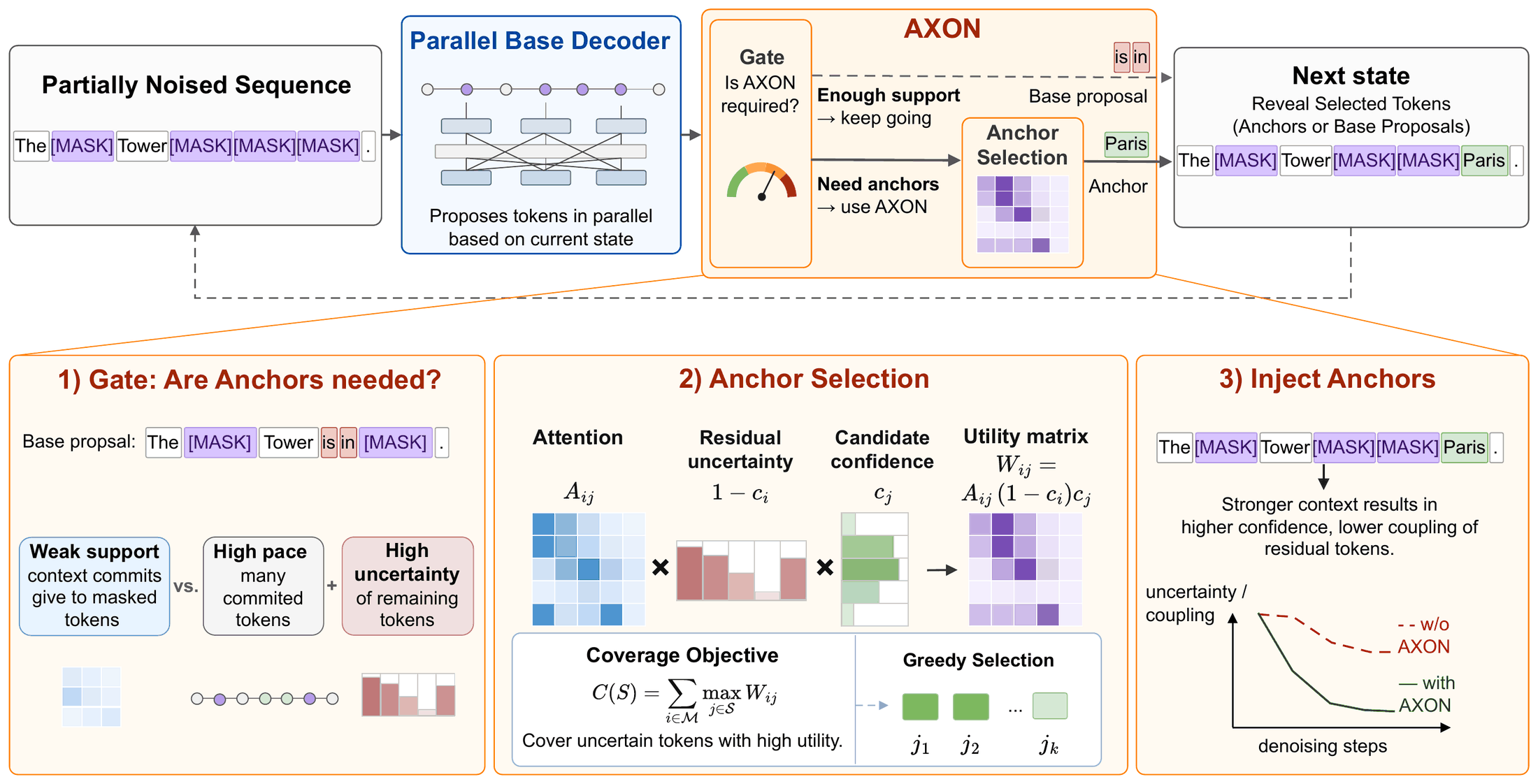 Click to enlarge
Highlights
Fewer forward passes. No retraining.
- Training-free plug-in; the backbone stays frozen.
- Gated intervention using existing attention and confidence signals.
18.6%
fewer forward passes on HumanEval with LLaDA-1.5
DAWN + AXON (k = 1)
NFE 77.3 → 62.9
Accuracy 42.07 → 42.68%
NFE 77.3 → 62.9
Accuracy 42.07 → 42.68%
14.8%
fewer forward passes on HumanEval with Dream-v0-Instruct-7B
DAWN + AXON (k = 1)
NFE 76.2 → 64.9
Accuracy 54.88 → 55.60%
NFE 76.2 → 64.9
Accuracy 54.88 → 55.60%
29/36
settings where AXON needs fewer forward passes than its base decoder
3 backbones × 4 benchmarks × 3 base decoders
26/36
settings where AXON is more accurate than its base decoder
same 36 settings
Forward passes per sample: base decoder vs. + AXON
Benchmark
Base decoder
0120 forward passes (NFE)
NFE = forward passes of the model per sample (fewer is faster). AXON injects k = 1 anchor per gated step; AXONCVR adds anchors until their coverage matches the base proposal's. Full table in the paper.
AXON in action
Same problem, same decoder. Half the steps.
Both animations decode HumanEval/47 (median) with LLaDA-1.5 and the DAWN base decoder. DAWN alone needs 107 steps and its output fails the unit test; with AXON, the gate detects the stalls and reveals anchors (blue), un-blocking the surrounding tokens.
DAWN107 steps · 2.39 tok/step · fails unit test

DAWN + AXON54 steps · 4.74 tok/step · gate 7× · passes unit test

